
After your surgery · Nicholas Genovese, M.D.
Mallet finger DIP pinning
Pin fixation to hold the fingertip joint in position while it heals
About your surgery
- A pin (K-wire) is holding the fingertip joint (DIP joint) in position while it heals.
Day of surgery
The first three days
Keep your hand higher than your heart as much as you can. Rest it on pillows when you sit or sleep. This is the most important thing you can do for swelling and pain.
Put ice over the dressing or splint for 15–20 minutes at a time, several times a day. Never put ice directly on the skin, and do not let the dressing get wet.
Move the parts that are not in the dressing or splint: open and close your fingers, and gently move your elbow and shoulder every hour while awake.
Some swelling, bruising and soreness are normal. Bruising can travel down into the fingers.
Use the hand for light tasks only. Do not lift anything heavier than a coffee cup with the operated hand until your surgeon tells you that you can.
Dressing and bathing
Your finger is covered with a non-stick gauze dressing, a light gauze wrap and a self-adherent elastic wrap. The pin is protected under the dressing.
Keep the dressing clean, dry and in place at all times. Do not remove, adjust or trim it, and do not put anything inside it.
Do not pull, twist or snag the pin. Call the office if the pin shifts, catches on clothing, or the dressing becomes soaked with blood or drainage.
You may shower after 24 hours if you keep the dressing dry with a waterproof bag taped around the hand.
Do not swim or submerge the hand in water until the pin is removed and your surgeon says the wound is healed.
Splint or sling
- Keep the finger protected exactly as it was dressed after surgery.
- Do not bend or exercise the pinned fingertip joint. Gently move only the fingers and joints that are not held by the pin or dressing.
Pain control
Follow the plan your surgeon gave you and the directions on your prescription labels. Unless you were told otherwise, the plan below works well for most patients.
Acetaminophen (Tylenol 8 HR Arthritis Pain, 650 mg): one tablet every 8 hours for the first 3 days, even if your pain is mild, then as needed. Do not take more than 3,000 mg of acetaminophen a day from all sources. Many prescription pain pills also contain acetaminophen, so count them too.
Naproxen 500 mg (or the anti-inflammatory your surgeon prescribed): twice a day with food for the first 3 days, then as needed. Only take it if anti-inflammatory medicine is safe for you. Do not take it if you have kidney disease, a stomach ulcer or stomach bleeding, take a blood thinner, are pregnant, or were told to avoid these medicines.
Stronger prescription medicine for breakthrough pain: take it only as written on the label, and only if you need it, usually at night. It can cause drowsiness and constipation. Drink 6–8 glasses of water a day and use a stool softener such as Colace while you take it. Do not drive, drink alcohol or make important decisions while taking it.
The worst pain is usually in the first 48 hours. Most patients need nothing stronger than acetaminophen and naproxen after 3–5 days.
Prescription refills and changes are handled during business hours only, not at night or on weekends.
Activity and lifting limit
- Use the hand only for light tasks. Do not lift more than a coffee cup with the operated hand for the first 2 weeks.
- Avoid forceful gripping and heavy lifting while the pin and dressing are in place.
Driving
Do not drive while you are taking prescription pain medicine, while your arm is numb from a block, or while a splint or dressing keeps you from controlling the wheel safely.
Exercises to start now
Do these exercises 3–5 times a day. Move gently within the dressing. Mild stretching is okay, but stop if symptoms steadily worsen.
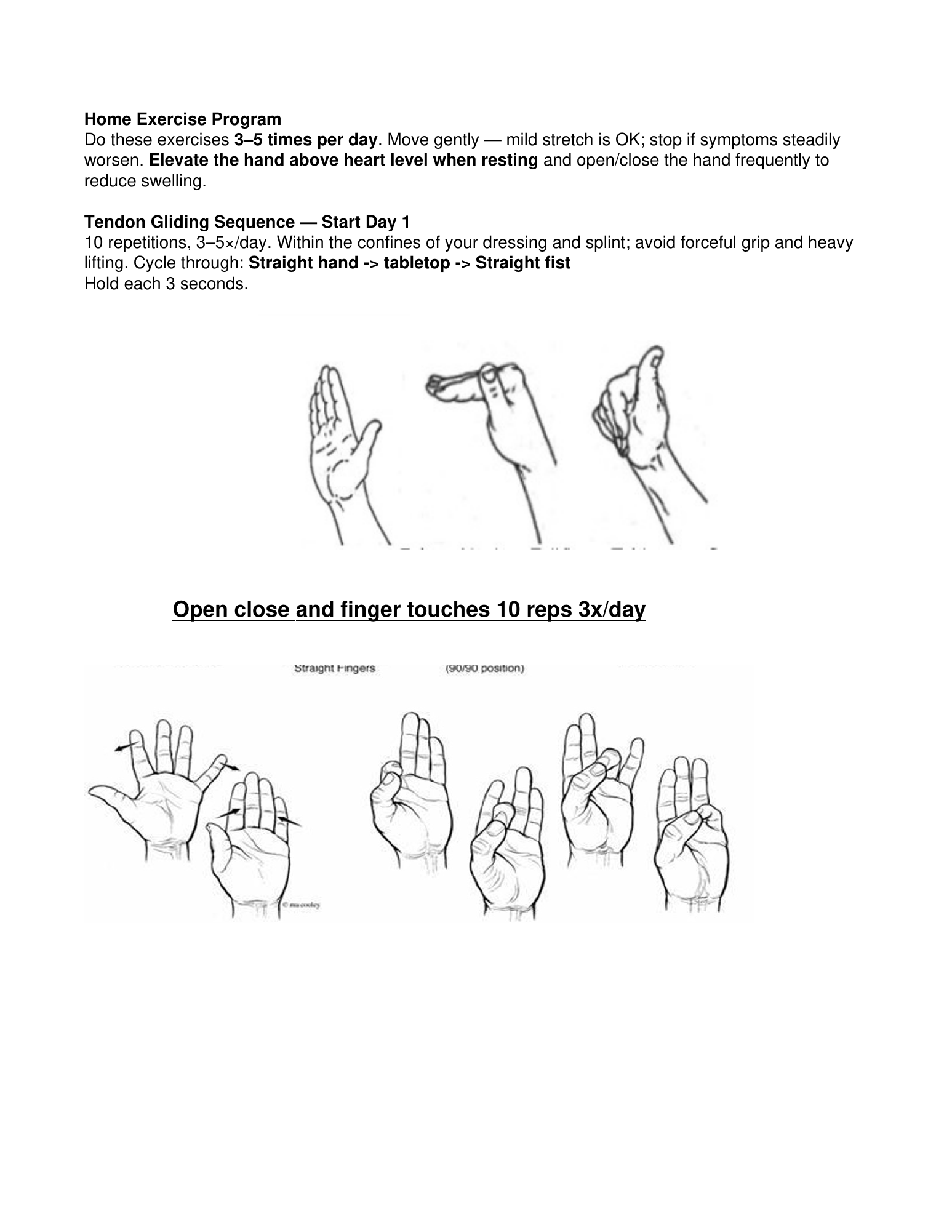
Move the unprotected fingers from a straight hand to a tabletop position, then to a straight fist. Hold each position for 3 seconds. Repeat 10 times.
Open and close the unprotected fingers, then touch the thumb to each unprotected fingertip. Repeat 10 times, 3 times a day.
Your regular medicines
Restart your usual home medicines only as directed in the discharge plan your care team gave you.
If you are unsure whether to restart a medicine, call the office before taking it.
Protected finger exercises
Your first post-op visit
Your first post-op visit is usually about 2 weeks after surgery. The date and office are on your appointment card. If you cannot make it, call (858) 560-0242.
When to call the office
Call the office at (858) 560-0242 immediately if you have any of the following:
- Fever above 101.0 °F or chills
- Redness, warmth or red streaks spreading from the incision
- Drainage from the incision, especially cloudy or bad-smelling drainage
- Pain that is getting worse or is not controlled by your medicines
- New or worsening numbness, tingling or weakness
- Fingers that turn blue, white or cold, or stay very swollen after elevating your hand for an hour
- A splint or wrap that still feels too tight after you loosen the outer elastic wrap and elevate your hand
- Bleeding that soaks through the dressing
- The pin shifts, becomes loose, or catches on clothing
If you cannot reach us and the problem is urgent, go to the nearest emergency room or call 911.
Call 911 or go to the nearest emergency room for chest pain, trouble breathing, or new calf pain or swelling.
After your first post-op visit: home exercises
General principles
Start these at or after your first post-op visit, when your surgeon or therapist tells you to.
What not to do yet
- Use the hand only for light tasks. Do not lift more than a coffee cup with the operated hand for the first 2 weeks.
- Avoid forceful gripping and heavy lifting while the pin and dressing are in place.
When to call the office
Call the office at (858) 560-0242 immediately if you have any of the following:
- Fever above 101.0 °F or chills
- Redness, warmth or red streaks spreading from the incision
- Drainage from the incision, especially cloudy or bad-smelling drainage
- Pain that is getting worse or is not controlled by your medicines
- New or worsening numbness, tingling or weakness
- Fingers that turn blue, white or cold, or stay very swollen after elevating your hand for an hour
- A splint or wrap that still feels too tight after you loosen the outer elastic wrap and elevate your hand
- Bleeding that soaks through the dressing
- The pin shifts, becomes loose, or catches on clothing
If you cannot reach us and the problem is urgent, go to the nearest emergency room or call 911.
Call 911 or go to the nearest emergency room for chest pain, trouble breathing, or new calf pain or swelling.
About these instructions
These instructions are general guidelines for patients of Nicholas Genovese, M.D. Your surgeon may change your plan based on your surgery and how you are healing. If anything here differs from what your surgeon or therapist told you, follow their instructions, and call the office before changing any activity, splint use or therapy.